
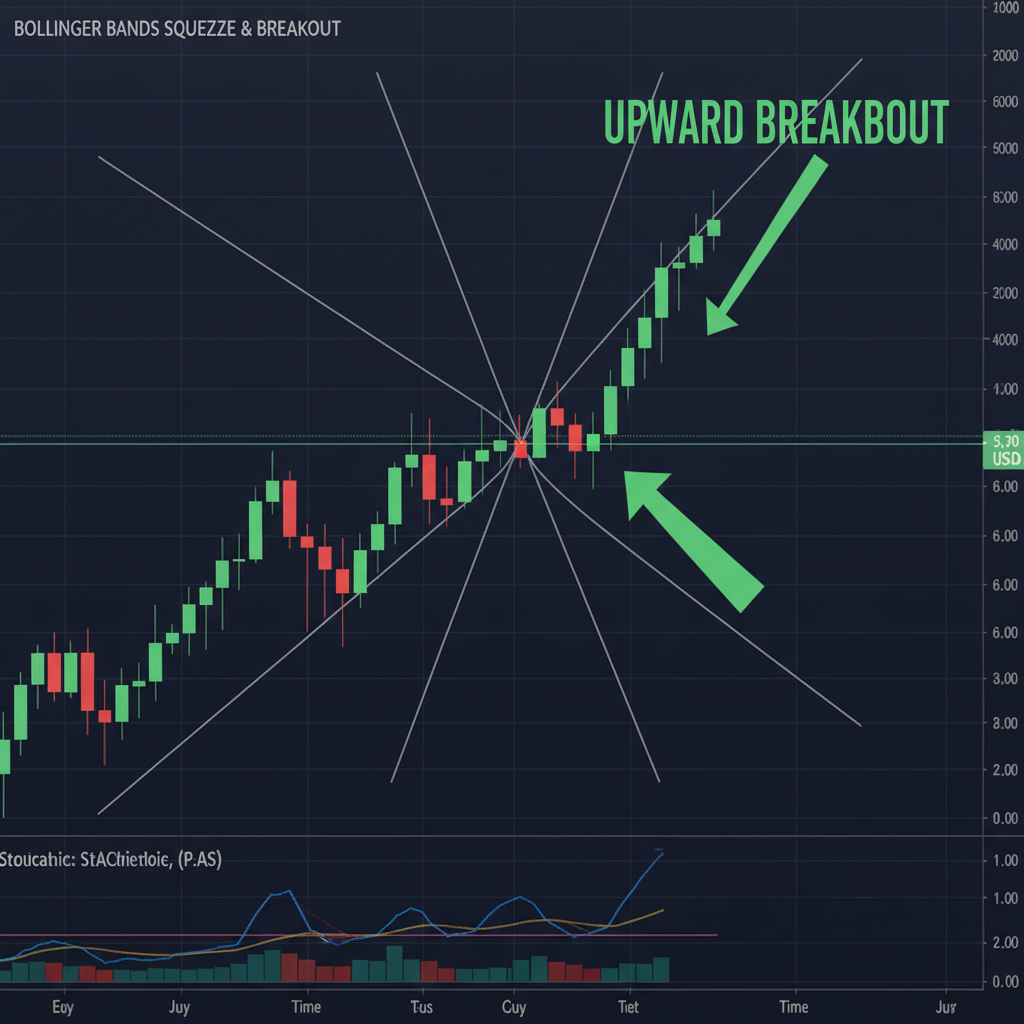
The Bollinger Band breakout trading strategy represents one of the most powerful volatility-based trading approaches available to beginner traders. This comprehensive Bollinger Band breakout system helps traders identify periods of low volatility followed by explosive price movements, creating exceptional profit opportunities in any market condition.
Understanding Bollinger Bands for Breakout Trading
Bollinger Bands consist of three essential components that form the foundation of this Bollinger Band breakout trading strategy. The middle band represents a 20-period simple moving average, while the upper and lower bands are positioned two standard deviations above and below this centerline. This Bollinger Band breakout configuration captures approximately 95% of price action under normal market conditions.
The genius of the Bollinger Band breakout trading strategy lies in its ability to adapt to changing market volatility. When markets experience low volatility, the bands contract, creating what traders call a “squeeze.” Conversely, during high volatility periods, the bands expand to accommodate larger price swings, setting up perfect conditions for Bollinger Band breakout opportunities.
The Three Phases of Bollinger Band Breakout Patterns
Phase 1: The Squeeze Formation
The Bollinger Band breakout trading strategy begins with identifying the squeeze phase, where the bands narrow significantly around the price action. During this Bollinger Band breakout setup phase, volatility decreases, trading volume typically declines, and price movement becomes confined within the contracting bands. The longer and tighter this squeeze persists, the more explosive the eventual Bollinger Band breakout tends to become.
Phase 2: The Breakout Signal
The critical moment in any Bollinger Band breakout trading strategy occurs when price decisively closes outside either the upper or lower band. This Bollinger Band breakout signal must be accompanied by increased volume and expanded candle sizes, indicating renewed market interest and participation. Successful traders wait for these confirmation signals before executing their Bollinger Band breakout trades.
Phase 3: The Follow-Through Movement
After the initial Bollinger Band breakout, three scenarios typically unfold in this Bollinger Band breakout trading strategy. Strong trends continue moving in the breakout direction with expanding bands, false breakouts quickly reverse back inside the bands, or price “rides” along the band using it as dynamic support or resistance.
Essential Bollinger Band Breakout Trading Strategy Setup
Optimal Settings for Beginner Traders
The standard Bollinger Band breakout trading strategy employs a 20-period moving average with 2 standard deviations. However, beginner traders can benefit from modified settings depending on their trading timeframe. For scalping, use a 10-period average with 1.5 standard deviations, while swing traders should consider 50-period settings with 2.5 standard deviations for their Bollinger Band breakout approach.
Identifying High-Probability Breakout Setups
Successful Bollinger Band breakout trading strategy implementation requires recognizing specific market conditions. Look for bands that have been contracting for at least 10-20 periods, with the Bollinger BandWidth indicator near its six-month lows. The most reliable Bollinger Band breakout opportunities occur after extended periods of band compression, typically lasting 20-30 trading days.
Step-by-Step Bollinger Band Breakout Trading Strategy
Entry Criteria and Confirmation Signals
Execute your Bollinger Band breakout trading strategy only when multiple confirmation signals align. Wait for a decisive candle close beyond either band, accompanied by volume significantly higher than recent averages. The Bollinger Band breakout signal becomes stronger when it occurs at key support or resistance levels, particularly after prolonged squeeze patterns.
For bullish Bollinger Band breakout trades, enter long positions when price closes above the upper band with strong volume confirmation. Bearish Bollinger Band breakout opportunities arise when price closes below the lower band with similar volume characteristics. Always ensure the Bollinger Band breakout aligns with the broader market trend for maximum probability of success.
Risk Management in Bollinger Band Breakout Trading
Proper risk management forms the cornerstone of any successful Bollinger Band breakout trading strategy. Place stop-loss orders just inside the opposite band from your entry point. For long positions in this Bollinger Band breakout approach, set stops below the lower band or recent swing lows. Short positions require stops above the upper band or recent swing highs.
Target setting in your Bollinger Band breakout trading strategy can utilize multiple approaches. Measure the height of the previous trading range during the squeeze phase, or use a risk-reward ratio of at least 2:1. Many successful traders trail their stops as the Bollinger Band breakout continues, allowing profits to run while protecting against reversal risks.
Advanced Bollinger Band Breakout Confirmation Techniques
Volume Analysis for Breakout Validation
Volume serves as the ultimate validator in any Bollinger Band breakout trading strategy. Genuine breakouts typically demonstrate volume spikes of 150-200% above recent averages. Without this volume confirmation, many apparent Bollinger Band breakout signals prove to be false, leading to quick reversals and stopped-out positions.
Combining Technical Indicators
Enhance your Bollinger Band breakout trading strategy by incorporating complementary indicators. The Relative Strength Index (RSI) helps identify momentum strength, with readings between 50-70 supporting bullish breakouts. The MACD indicator provides additional momentum confirmation, while moving averages help determine the broader trend direction for your Bollinger Band breakout trades.
Common Mistakes in Bollinger Band Breakout Trading Strategy
Avoiding False Breakout Traps
The most significant pitfall in Bollinger Band breakout trading strategy involves falling for false breakout signals. These occur when price briefly breaches a band but lacks the volume and momentum to sustain the move. Avoid this trap by waiting for decisive closes beyond the bands, preferably with multiple consecutive closes in the breakout direction.
Overtrading Band Touches
Novice traders often mistake every band touch for a Bollinger Band breakout opportunity. Remember that during strong trends, price can “ride” along a band for extended periods without reversing. Only trade band interactions that occur after clear squeeze patterns or with strong momentum confirmation in your Bollinger Band breakout trading strategy.
Real-World Bollinger Band Breakout Examples
Successful Breakout Case Study
Consider a recent example where a stock demonstrated classic Bollinger Band breakout trading strategy characteristics. After a week-long squeeze with declining volume, price explosively broke above the upper band with 300% higher volume. This Bollinger Band breakout led to a sustained 10% move higher over the following days, rewarding patient traders who waited for proper confirmation.
Failed Breakout Analysis
Not all Bollinger Band breakout attempts succeed, making risk management crucial in your Bollinger Band breakout trading strategy. Failed breakouts often lack volume confirmation or occur against the prevailing trend. These false signals typically reverse quickly, emphasizing the importance of strict stop-loss placement and confirmation requirements.
Market-Specific Bollinger Band Breakout Applications
Stock Market Implementation
The Bollinger Band breakout trading strategy works exceptionally well in stock markets, particularly during earnings seasons or major news events. Individual stocks often experience significant volatility expansions following periods of consolidation, creating ideal conditions for Bollinger Band breakout opportunities. Focus on stocks with strong fundamentals and clear technical patterns for the highest success rates.
Forex and Cryptocurrency Markets
Currency pairs and cryptocurrency markets provide excellent venues for Bollinger Band breakout trading strategy implementation. These markets often experience dramatic volatility shifts due to economic announcements, regulatory news, or market sentiment changes. The 24-hour nature of these markets creates numerous Bollinger Band breakout opportunities for dedicated traders.
Timeframe Considerations for Bollinger Band Breakout Trading
Short-Term Trading Applications
Day traders can effectively utilize the Bollinger Band breakout trading strategy on shorter timeframes, including 5-minute and 15-minute charts. Use tighter band settings (10-period, 1.5 standard deviations) for more frequent Bollinger Band breakout signals, but expect higher false breakout rates requiring strict risk management.
Swing Trading Approach
Swing traders benefit from longer-term Bollinger Band breakout trading strategy applications using daily or weekly charts. These timeframes produce more reliable Bollinger Band breakout signals with lower false positive rates, though opportunities occur less frequently. Use standard 20-period settings with 2 standard deviations for optimal results.
Psychology of Bollinger Band Breakout Trading
Managing Emotional Responses
Successful Bollinger Band breakout trading strategy execution requires strong emotional discipline. The waiting period during squeeze formations tests patience, while rapid breakout movements can trigger fear or greed responses. Develop a systematic approach to your Bollinger Band breakout trades, following predetermined rules regardless of emotional impulses.
Building Confidence Through Practice
Master the Bollinger Band breakout trading strategy through extensive backtesting and paper trading before risking real capital. Study historical charts to identify successful Bollinger Band breakout patterns, understanding both winning and losing scenarios. This preparation builds the confidence necessary for decisive action when real opportunities arise.
Advanced Bollinger Band Breakout Techniques
Multi-Timeframe Analysis
Sophisticated traders enhance their Bollinger Band breakout trading strategy using multiple timeframe analysis. Confirm breakout signals on your primary trading timeframe by checking higher timeframes for trend alignment. This approach significantly improves the success rate of Bollinger Band breakout trades while reducing false signal frequency.
Seasonal and Market Cycle Considerations
Certain market conditions favor Bollinger Band breakout trading strategy implementation more than others. Earnings seasons, economic announcement periods, and market transition phases often produce ideal volatility patterns for Bollinger Band breakout opportunities. Understanding these cycles helps traders position themselves for the most profitable trading periods.
Technology and Tools for Bollinger Band Breakout Trading
Screening for Breakout Opportunities
Modern trading platforms offer sophisticated screening tools for identifying potential Bollinger Band breakout setups. Create scans that filter for stocks or instruments showing band contractions, declining BandWidth values, and approaching historical volatility lows. These screens help systematically identify the best Bollinger Band breakout trading strategy opportunities.
Alert Systems and Automation
Set up alert systems to notify you when Bollinger Band breakout conditions develop. Many platforms allow custom alerts based on band contractions, volume spikes, or price breakouts. While full automation isn’t recommended for beginners, these alerts ensure you don’t miss high-quality Bollinger Band breakout opportunities.
#BollingerBands #BreakoutTrading #TechnicalAnalysis #TradingStrategy #VolatilityTrading #StockMarket #ForexTrading #SwingTrading #DayTrading #TradingEducation #MarketAnalysis #TradingSignals #RiskManagement #TradingTips #BeginnersTrading
Bollinger Bands breakout trading strategy illustration for beginners
Disclaimer
This article is provided for educational purposes only and does not constitute financial advice. Trading involves substantial risk and may not be suitable for all investors. The Bollinger Band breakout trading strategy discussed herein should be thoroughly tested and understood before implementation with real capital. Past performance does not guarantee future results, and all trading decisions should be made based on individual risk tolerance and financial circumstances. Always consult with qualified financial professionals before making investment decisions.