
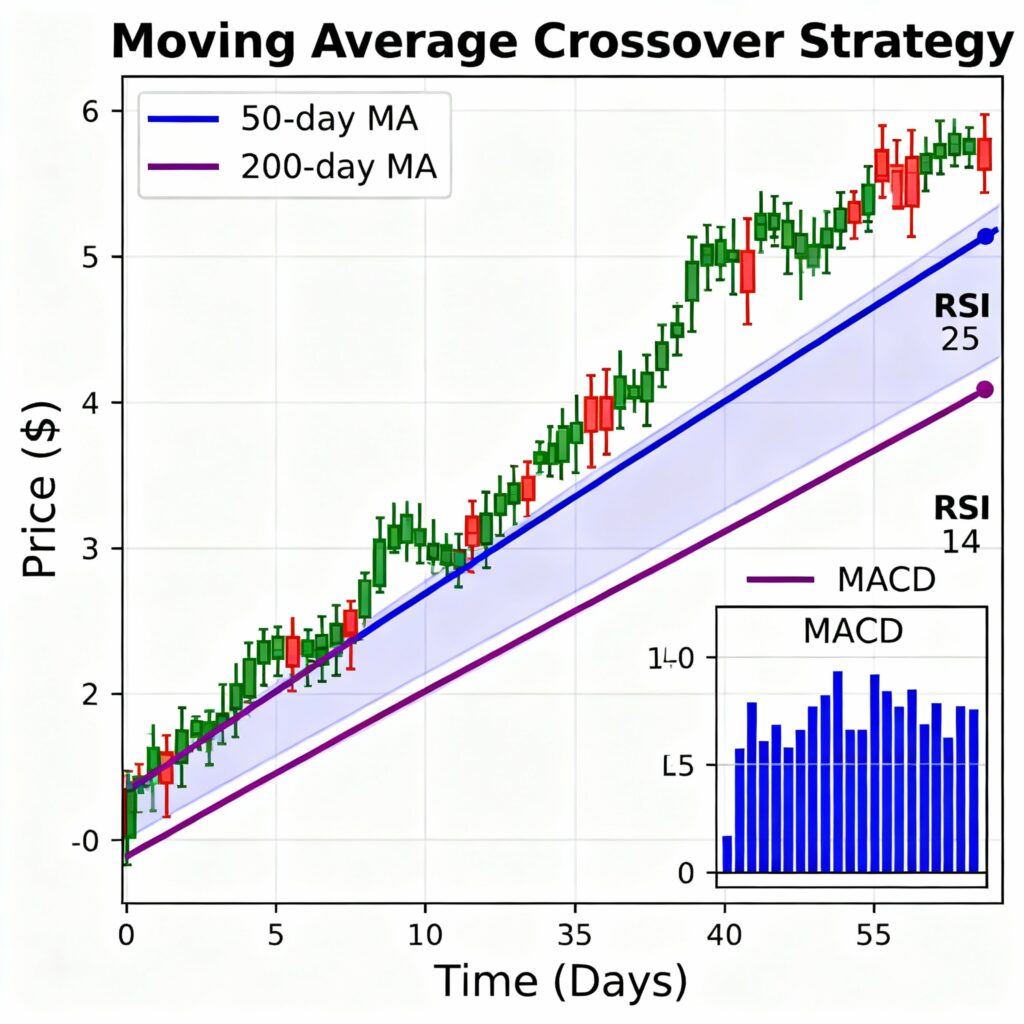
The intraday moving average crossover strategy represents one of the most fundamental and reliable technical analysis approaches for beginner traders entering the dynamic world of day trading. This comprehensive strategy utilizes the intersection of different moving averages to generate precise buy and sell signals within a single trading session, making it an ideal starting point for traders seeking consistent market entry and exit opportunities.
Understanding the Foundation of Intraday Moving Average Crossover Strategy
The intraday moving average crossover strategy operates on the principle that when shorter-term moving averages cross above or below longer-term moving averages, they signal potential trend changes and trading opportunities. For beginner traders, this strategy provides clear, objective signals that remove emotional decision-making from the trading process.
Moving averages smooth out price fluctuations by calculating the average price over specific periods, with the intraday moving average crossover strategy typically employing Exponential Moving Averages (EMAs) rather than Simple Moving Averages (SMAs) due to their superior responsiveness to recent price movements. The exponential calculation gives greater weight to recent prices, making EMAs particularly suitable for the fast-paced nature of intraday trading.
Professional moving average crossover trading strategy visualization for beginner traders
Popular Intraday Moving Average Crossover Strategy Configurations
The 9/20 EMA Crossover Method
The most widely adopted intraday moving average crossover strategy among beginner traders utilizes 9-period and 20-period EMAs. This configuration provides an optimal balance between signal frequency and reliability, generating approximately 3-5 trading opportunities per day in active stocks.
When implementing this intraday moving average crossover strategy, traders look for the 9 EMA crossing above the 20 EMA as a bullish signal, indicating potential upward price movement. Conversely, when the 9 EMA crosses below the 20 EMA, it generates a bearish signal suggesting downward momentum.
The 5/15 Minute Timeframe Approach
For more aggressive intraday traders, the intraday moving average crossover strategy can be applied using 5-minute and 15-minute charts with corresponding moving averages. This faster configuration captures quick price movements but requires enhanced risk management due to increased signal frequency and potential false signals.
The Triple Moving Average System
Advanced practitioners of the intraday moving average crossover strategy often incorporate a third moving average, typically using 9, 21, and 55-period EMAs. This triple crossover system provides additional confirmation and reduces false signals, though it may result in fewer trading opportunities throughout the day.
Step-by-Step Implementation of Intraday Moving Average Crossover Strategy
Phase 1: Market Preparation and Setup
Before executing any intraday moving average crossover strategy trades, beginner traders must establish proper market preparation protocols. This includes selecting liquid stocks with sufficient trading volume, typically large-cap stocks that demonstrate consistent intraday volatility and tight bid-ask spreads.
The optimal trading window for the intraday moving average crossover strategy occurs during the first 30 minutes after market opening and the final 45 minutes before market closure, when volatility and volume are typically highest. However, the middle trading hours can also provide profitable opportunities with reduced market noise.
Phase 2: Signal Identification and Confirmation
Successful implementation of the intraday moving average crossover strategy requires traders to wait for clear crossover signals accompanied by supporting volume and price action. A valid buy signal occurs when the shorter EMA crosses definitively above the longer EMA, preferably with increased trading volume confirming the move.
Before entering any position based on the intraday moving average crossover strategy, traders should confirm the signal using additional technical indicators such as RSI or MACD to avoid false breakouts. This confirmation process significantly improves the strategy’s success rate and reduces the likelihood of entering losing trades.
Phase 3: Entry and Exit Execution
The intraday moving average crossover strategy demands precise entry timing, with traders typically entering positions immediately after the crossover confirmation candle closes. For long positions, entry occurs when the price closes above both moving averages with the shorter EMA positioned above the longer EMA.
Exit strategies within the intraday moving average crossover strategy follow predefined rules, including profit targets set at 2-3% above entry price and stop-loss levels positioned 1-1.5% below entry price for long positions. These risk-reward ratios ensure profitability even with moderate win rates.
Risk Management Principles for Intraday Moving Average Crossover Strategy
Position Sizing and Capital Allocation
Effective risk management forms the cornerstone of successful intraday moving average crossover strategy implementation. Beginner traders should risk no more than 1-2% of their total trading capital on any single trade, ensuring that multiple consecutive losses won’t significantly impact their account balance.
The intraday moving average crossover strategy requires disciplined position sizing, with traders calculating appropriate share quantities based on their predetermined stop-loss levels and maximum acceptable loss per trade. This mathematical approach removes emotional decision-making and maintains consistent risk exposure across all trades.
Stop-Loss Implementation and Management
Every trade executed using the intraday moving average crossover strategy must include a predefined stop-loss order placed immediately upon position entry. For long positions, stop-losses are typically positioned 1-2% below the entry price or just below the longer moving average, whichever provides better risk management.
Trailing stop-loss techniques can enhance the intraday moving average crossover strategy by protecting profits as trades move favorably. As the price advances, traders adjust their stop-loss levels upward, maintaining a fixed percentage or dollar amount below the current market price.
Common Mistakes and How to Avoid Them
Overtrading and Signal Chasing
One of the most frequent errors committed by beginner traders implementing the intraday moving average crossover strategy involves overtrading and chasing every potential signal. Quality over quantity should guide trade selection, with traders focusing on the strongest crossover signals accompanied by volume confirmation and favorable market conditions.
The intraday moving average crossover strategy works best when traders maintain patience and wait for optimal setups rather than forcing trades during choppy or sideways market conditions. Avoiding low-quality signals significantly improves overall profitability and reduces unnecessary transaction costs.
Ignoring Market Context and News Events
Successful intraday moving average crossover strategy implementation requires awareness of broader market conditions and scheduled news events that might impact price action. Major economic announcements, earnings releases, or geopolitical events can cause sudden price movements that invalidate technical signals.
Traders should avoid implementing the intraday moving average crossover strategy during periods of high market uncertainty or immediately before significant news releases. This protective approach prevents unexpected losses from news-driven price gaps that might breach stop-loss levels.
Advanced Techniques and Optimization Methods
Multi-Timeframe Analysis Integration
Experienced practitioners of the intraday moving average crossover strategy often incorporate multiple timeframe analysis to improve signal reliability. By confirming intraday crossover signals with trends visible on daily and weekly charts, traders can identify higher-probability trade setups aligned with broader market momentum.
The intraday moving average crossover strategy becomes more powerful when shorter-term signals align with longer-term trend directions, creating confluence that increases the likelihood of successful trades. This multi-timeframe approach requires additional analysis but significantly improves win rates.
Volume Weighted Average Price (VWAP) Integration
Combining the intraday moving average crossover strategy with VWAP analysis provides additional context for trade decisions. When crossover signals occur near VWAP levels, they often carry increased significance and generate stronger price movements.
The integration of VWAP with the intraday moving average crossover strategy helps traders identify optimal entry points and gauge institutional participation in price moves. This combination creates more sophisticated trading setups suitable for intermediate-level traders.
Technology and Platform Requirements
Charting Software and Data Feeds
Effective implementation of the intraday moving average crossover strategy requires reliable charting software with real-time data feeds and customizable moving average indicators. Popular platforms include TradingView, MetaTrader, and broker-provided applications that offer comprehensive technical analysis tools.
The intraday moving average crossover strategy demands tick-by-tick data accuracy to ensure precise crossover identification and timely trade execution. Delayed or inaccurate data can result in missed opportunities or false signals that negatively impact trading performance.
Alert Systems and Automation
Modern trading platforms allow traders to set automated alerts for intraday moving average crossover strategy signals, ensuring they never miss potential opportunities. These alerts can be delivered via email, SMS, or push notifications, enabling traders to monitor multiple stocks simultaneously.
While automation can enhance the intraday moving average crossover strategy, beginner traders should maintain manual oversight to evaluate market conditions and confirm signal quality before entering trades. Complete automation without human judgment often leads to poor trade selection and increased losses.
Performance Measurement and Improvement
Trade Journal and Analysis
Successful intraday moving average crossover strategy practitioners maintain detailed trade journals documenting entry and exit points, signal quality, market conditions, and outcome analysis. This systematic record-keeping enables continuous strategy refinement and identification of optimal trading conditions.
Regular review of intraday moving average crossover strategy performance helps traders identify patterns in their winning and losing trades, enabling strategic adjustments and improved decision-making. Monthly performance analysis should include win rate, average profit/loss ratios, and maximum drawdown statistics.
Continuous Learning and Adaptation
The intraday moving average crossover strategy evolves with changing market conditions, requiring traders to continuously update their knowledge and adapt their approaches. Regular study of market behavior, economic factors, and technical analysis developments ensures strategy effectiveness over time.
Successful implementation of the intraday moving average crossover strategy demands ongoing education through books, courses, webinars, and practical experience. Beginner traders should invest significant time in learning before risking substantial capital in live trading environments.
Keywords: intraday moving average crossover strategy, moving average crossover, EMA crossover, intraday trading, technical analysis, day trading strategy, beginner trading, stock market strategy, moving averages, trading signals
Hashtags: #IntradayTrading #MovingAverageCrossover #DayTrading #TechnicalAnalysis #StockTrading #BeginnerTrading #EMAStrategy #TradingSignals #MarketAnalysis #TradingEducation
DISCLAIMER
Important Disclaimer: This article on intraday moving average crossover strategy is provided for educational and informational purposes only. The content presented here should not be considered as personalized investment advice, financial consulting, or a recommendation to buy or sell any specific securities or financial instruments.
Trading in financial markets, including the implementation of intraday moving average crossover strategies, involves substantial risk of loss and may not be suitable for all investors. Past performance of any trading strategy does not guarantee future results. The volatile nature of intraday trading can result in significant financial losses, potentially exceeding your initial investment.
Before implementing any intraday moving average crossover strategy or making investment decisions, please consult with qualified financial advisors or investment professionals who can assess your individual financial situation, risk tolerance, and investment objectives. Always conduct thorough research and consider seeking independent professional advice.
Trading Strategys (www.tradingstrategys.com) and its authors disclaim any liability for losses or damages that may result from the use of information contained in this educational article. All trading decisions and their consequences remain solely your responsibility.