
Introduction to Risk Management Strategies in Trading
Risk management strategies form the cornerstone of successful trading, serving as the protective shield that separates professional traders from those who gamble with their capital. In the dynamic world of financial markets, where uncertainty is the only constant, implementing robust risk management strategies becomes not just advisable but absolutely essential for long-term trading success.
The trading landscape of 2025 presents unique challenges with increased market volatility, algorithmic trading dominance, and rapid price movements that can quickly erode trading capital. Risk management strategies encompass a comprehensive framework of techniques, tools, and methodologies designed to identify, assess, and mitigate potential losses while optimizing profit potential. These strategies transform trading from mere speculation into a calculated business approach where risk management strategies serve as the foundation for sustainable profitability.
Understanding and implementing effective risk management strategies allows traders to navigate market uncertainties with confidence, ensuring that no single trade or market event can significantly damage their trading account. The core principle behind all risk management strategies is capital preservation – the fundamental concept that protecting your trading capital should always take precedence over chasing profits.
Core Principles of Effective Risk Management Strategies
The foundation of all successful risk management strategies rests on several fundamental principles that guide every trading decision. The first principle involves risk identification, where traders systematically catalog potential threats to their trading capital, including market risk, credit risk, liquidity risk, and operational risk. Risk management strategies require traders to acknowledge that losses are an inevitable part of trading and prepare accordingly.
Risk assessment forms the second pillar of effective risk management strategies, involving the quantification and evaluation of identified risks based on their probability of occurrence and potential impact on the trading portfolio. This assessment enables traders to prioritize which risks require immediate attention and which can be monitored over time. Risk management strategies must incorporate both qualitative and quantitative analysis methods to provide a comprehensive view of portfolio exposure.
The third principle centers on risk mitigation, where traders implement specific techniques and tools to reduce or eliminate identified risks. These risk management strategies may include diversification across asset classes, sectors, and geographic regions, as well as employing hedging techniques such as options, futures, and derivatives. The goal is not to eliminate all risk – which would also eliminate profit potential – but to manage risk to acceptable levels.
Continuous monitoring and adjustment represent the fourth principle of risk management strategies, acknowledging that risk management is an ongoing process rather than a one-time activity. Market conditions change constantly, requiring traders to regularly reassess their risk exposure and adjust their risk management strategies accordingly. This dynamic approach ensures that risk management strategies remain effective across different market environments.
Position Sizing: The Foundation of Risk Management Strategies
Position sizing stands as perhaps the most critical component of risk management strategies, determining how much capital to allocate to each individual trade based on account size, risk tolerance, and market conditions. Effective risk management strategies require precise position sizing to ensure that no single trade can cause catastrophic damage to the trading account.
The fixed percentage method represents one of the most popular risk management strategies for position sizing, where traders risk a predetermined percentage of their total account value on each trade, typically ranging from 1% to 2%. This approach ensures that as the account grows through profitable trading, position sizes automatically increase, allowing for compound growth while maintaining consistent risk levels. Risk management strategies employing fixed percentage methods provide built-in protection against account depletion.
Risk-based position sizing forms another cornerstone of effective risk management strategies, where position size is determined by the distance between entry point and stop-loss level. This method ensures that traders maintain consistent dollar risk across all trades regardless of the specific asset being traded. Risk management strategies utilizing this approach calculate position size by dividing the desired dollar risk by the difference between entry and stop-loss prices.
The Kelly Criterion offers a more sophisticated approach to position sizing within risk management strategies, utilizing mathematical formulas to optimize position sizes based on win rates and average profit-to-loss ratios. While more complex to implement, this method can significantly enhance long-term returns when incorporated into comprehensive risk management strategies. However, many traders modify the Kelly Criterion by using fractional Kelly sizing to reduce volatility and maintain more conservative risk management strategies.
Stop-Loss Orders: Essential Tools in Risk Management Strategies
Stop-loss orders serve as automatic exit mechanisms within risk management strategies, predetermined price levels where losing positions are closed to prevent further losses. These tools represent fundamental components of risk management strategies because they remove emotional decision-making from loss-cutting situations. Effective risk management strategies always incorporate stop-loss orders as a primary defense against large losses.
Technical analysis-based stop-loss placement forms a crucial element of sophisticated risk management strategies, utilizing support and resistance levels, moving averages, and other technical indicators to determine optimal exit points. Risk management strategies employing support-based stops place orders just below significant support levels for long positions, ensuring exits occur only when key technical levels are breached. This approach provides risk management strategies with logical, market-based exit criteria rather than arbitrary percentage-based stops.
Volatility-based stop-loss methods represent advanced risk management strategies that adjust stop distances based on market volatility using indicators like Average True Range (ATR). These risk management strategies recognize that different assets and market conditions require different stop distances to avoid premature exits while still providing adequate protection. By incorporating volatility measures, these risk management strategies adapt to changing market conditions automatically.
Trailing stop-loss orders offer dynamic protection within risk management strategies, automatically adjusting stop levels as positions move favorably. These risk management strategies allow traders to capture larger profits during trending markets while still maintaining downside protection. The key to successful trailing stop implementation in risk management strategies lies in setting appropriate trailing distances that balance profit capture with risk protection.
Diversification: Spreading Risk Through Smart Risk Management Strategies
Diversification represents one of the most fundamental risk management strategies, involving the strategic distribution of investments across different assets, sectors, time frames, and geographic regions to reduce overall portfolio risk. Effective risk management strategies recognize that diversification helps protect against the impact of poor performance in any single investment or market sector. The core principle underlying diversification in risk management strategies is that different assets often respond differently to the same economic events.
Asset class diversification forms a critical component of comprehensive risk management strategies, spreading investments across stocks, bonds, commodities, currencies, and alternative investments. These risk management strategies reduce correlation risk by ensuring that portfolio performance doesn’t depend entirely on one asset class. Risk management strategies incorporating asset class diversification can weather market storms better because losses in one asset class may be offset by gains in another.
Sector and industry diversification represent essential elements of risk management strategies, preventing overconcentration in specific economic sectors. These risk management strategies protect against sector-specific risks such as regulatory changes, technological disruption, or economic downturns affecting particular industries. Risk management strategies should typically limit exposure to any single sector to prevent catastrophic losses from industry-wide events.
Geographic diversification enhances risk management strategies by spreading investments across different countries and regions, protecting against country-specific political, economic, and currency risks. These risk management strategies become increasingly important in today’s interconnected global economy where regional events can have far-reaching consequences. Risk management strategies incorporating geographic diversification provide exposure to different economic cycles and growth opportunities while reducing concentration risk.
Portfolio Risk Assessment: Advanced Risk Management Strategies
Portfolio risk assessment forms the analytical backbone of sophisticated risk management strategies, providing quantitative and qualitative measures to evaluate overall portfolio risk exposure. These risk management strategies employ various metrics and tools to assess how different positions interact and affect overall portfolio volatility. Effective risk management strategies require regular portfolio risk assessment to identify concentration risks, correlation patterns, and potential vulnerabilities.
Value at Risk (VaR) calculations represent sophisticated risk management strategies that estimate potential losses over specific time periods at given confidence levels. These risk management strategies provide clear, quantifiable measures of downside risk that can be easily communicated to stakeholders and used for decision-making. Risk management strategies utilizing VaR models help traders understand their worst-case scenarios and plan accordingly.
Correlation analysis forms a crucial component of advanced risk management strategies, examining how different assets in the portfolio move relative to each other. These risk management strategies help identify hidden concentration risks where seemingly diversified portfolios actually contain highly correlated positions. Risk management strategies must account for correlation changes during market stress periods when correlations often increase dramatically.
Stress testing represents essential risk management strategies that evaluate portfolio performance under adverse market scenarios. These risk management strategies simulate various market crashes, economic downturns, and black swan events to assess portfolio resilience. Risk management strategies incorporating stress testing help traders prepare for extreme market conditions and adjust positions before problems occur.
Risk-Reward Analysis: Optimizing Risk Management Strategies
Risk-reward analysis forms the strategic heart of effective risk management strategies, ensuring that every trade offers adequate compensation for the risk undertaken. These risk management strategies require traders to analyze potential profits against potential losses before entering any position. Risk management strategies incorporating proper risk-reward analysis typically seek ratios of at least 1:2 or 1:3, meaning potential profits should exceed potential losses by significant margins.
Expected value calculations enhance risk management strategies by incorporating win rates and average gains/losses to determine the mathematical expectation of trading strategies. These risk management strategies help traders understand whether their approach will be profitable over the long term despite inevitable losing trades. Risk management strategies must ensure positive expected value to achieve sustainable profitability.
Risk-adjusted returns represent sophisticated risk management strategies that evaluate performance relative to risk taken, using metrics like the Sharpe ratio to compare different trading approaches. These risk management strategies help traders optimize their approach by identifying which methods provide the best returns per unit of risk. Risk management strategies should always prioritize risk-adjusted returns over absolute returns.
Portfolio heat mapping provides visual representation within risk management strategies, showing concentration and correlation risks across different positions and asset classes. These risk management strategies help traders quickly identify areas of overexposure and make informed decisions about position adjustments. Risk management strategies utilizing heat maps can prevent dangerous concentration buildups before they become problematic.
Technology and Tools for Modern Risk Management Strategies
Modern risk management strategies leverage advanced technology platforms and automated tools to enhance decision-making and execution efficiency. These technological risk management strategies include risk calculators, automated stop placement systems, and AI-powered risk analysis tools that help traders implement consistent risk management strategies. The integration of technology into risk management strategies allows for real-time monitoring and instant adjustments to changing market conditions.
Risk management platforms provide centralized solutions for implementing comprehensive risk management strategies across multiple accounts and asset classes. These sophisticated risk management strategies integrate various risk management functions including position sizing, stop-loss management, correlation analysis, and portfolio optimization into single platforms. Risk management strategies utilizing these platforms can achieve levels of sophistication and consistency that would be difficult to maintain manually.
Automated risk controls represent cutting-edge risk management strategies that implement predefined rules and limits without human intervention. These risk management strategies can include automatic position sizing, dynamic stop-loss adjustments, and portfolio rebalancing based on predetermined criteria. Risk management strategies incorporating automation reduce the impact of emotional decision-making and ensure consistent implementation of risk rules.
Real-time monitoring and alert systems enhance risk management strategies by providing instant notifications when risk parameters are exceeded or market conditions change significantly. These risk management strategies enable traders to respond quickly to developing situations and take corrective action before small problems become large losses. Risk management strategies must incorporate real-time monitoring to remain effective in today’s fast-moving markets.
Psychological Aspects of Risk Management Strategies
The psychological dimension of risk management strategies often determines whether traders successfully implement their planned risk controls or abandon them under pressure. Effective risk management strategies must account for common psychological biases such as loss aversion, overconfidence, and the tendency to hold losing positions too long while cutting winning positions too early. Risk management strategies that ignore psychological factors often fail during stressful market conditions when emotions run high.
Emotional discipline forms the foundation of successful risk management strategies, requiring traders to follow predetermined rules regardless of short-term emotions or market pressure. These risk management strategies emphasize the importance of treating trading as a business with consistent processes rather than gambling based on feelings. Risk management strategies must include specific protocols for handling emotional stress and maintaining discipline during difficult periods.
Trading journal maintenance represents practical risk management strategies that help traders identify patterns in their decision-making and emotional responses. These risk management strategies provide objective feedback about what works and what doesn’t, enabling continuous improvement in both technical and psychological aspects of trading. Risk management strategies incorporating detailed record-keeping allow traders to learn from both successes and failures.
Mental risk budgeting forms an often-overlooked component of comprehensive risk management strategies, helping traders mentally prepare for losses and maintain proper perspective during drawdown periods. These risk management strategies recognize that accepting losses as a normal part of trading is essential for long-term success. Risk management strategies must address the psychological preparation needed to implement difficult decisions like cutting losses or reducing position sizes.
Advanced Risk Management Strategies for Different Market Conditions
Market regime awareness represents sophisticated risk management strategies that adapt to different market environments such as trending, ranging, high volatility, and low volatility conditions. These risk management strategies recognize that techniques effective in trending markets may be counterproductive in ranging markets and vice versa. Risk management strategies must remain flexible and adaptable to changing market characteristics to maintain effectiveness.
Volatility-based risk adjustment forms advanced risk management strategies that modify position sizes, stop distances, and risk limits based on current market volatility levels. These risk management strategies increase risk controls during high volatility periods and may allow slightly larger positions during stable market conditions. Risk management strategies incorporating volatility measures provide more responsive and appropriate risk controls.
Correlation shifts during market stress require dynamic risk management strategies that account for the tendency of seemingly uncorrelated assets to move together during crisis periods. These risk management strategies must include stress-testing scenarios where traditional diversification benefits disappear. Risk management strategies should prepare for correlation breakdown and have contingency plans for extreme market conditions.
Liquidity risk management represents critical risk management strategies particularly important during market stress when normal liquidity may evaporate. These risk management strategies include maintaining appropriate cash reserves, avoiding overconcentration in illiquid assets, and having contingency plans for difficult exit scenarios. Risk management strategies must always consider how quickly positions can be closed under adverse conditions.
Implementation and Monitoring of Risk Management Strategies
Systematic implementation of risk management strategies requires documented procedures, regular reviews, and consistent execution across all trading activities. These risk management strategies must be written down, tested through backtesting or paper trading, and refined based on actual market experience. Risk management strategies that exist only in traders’ minds are often abandoned under pressure or forgotten during busy periods.
Regular review and adjustment of risk management strategies ensures they remain effective as market conditions, account sizes, and trading approaches evolve. These risk management strategies should be evaluated at least monthly to assess their effectiveness and identify areas for improvement. Risk management strategies must evolve with changing circumstances to maintain their protective benefits.
Performance measurement of risk management strategies involves tracking both protective effectiveness and impact on profitability to ensure optimal balance. These risk management strategies should be evaluated not just on losses prevented but also on their contribution to overall risk-adjusted returns. Risk management strategies that are too conservative may protect capital but prevent adequate profit generation.
Documentation and compliance with risk management strategies provides accountability and enables continuous improvement through detailed record-keeping. These risk management strategies create audit trails that help identify what works, what doesn’t, and why certain decisions were made. Risk management strategies benefit from thorough documentation that enables learning and refinement over time.
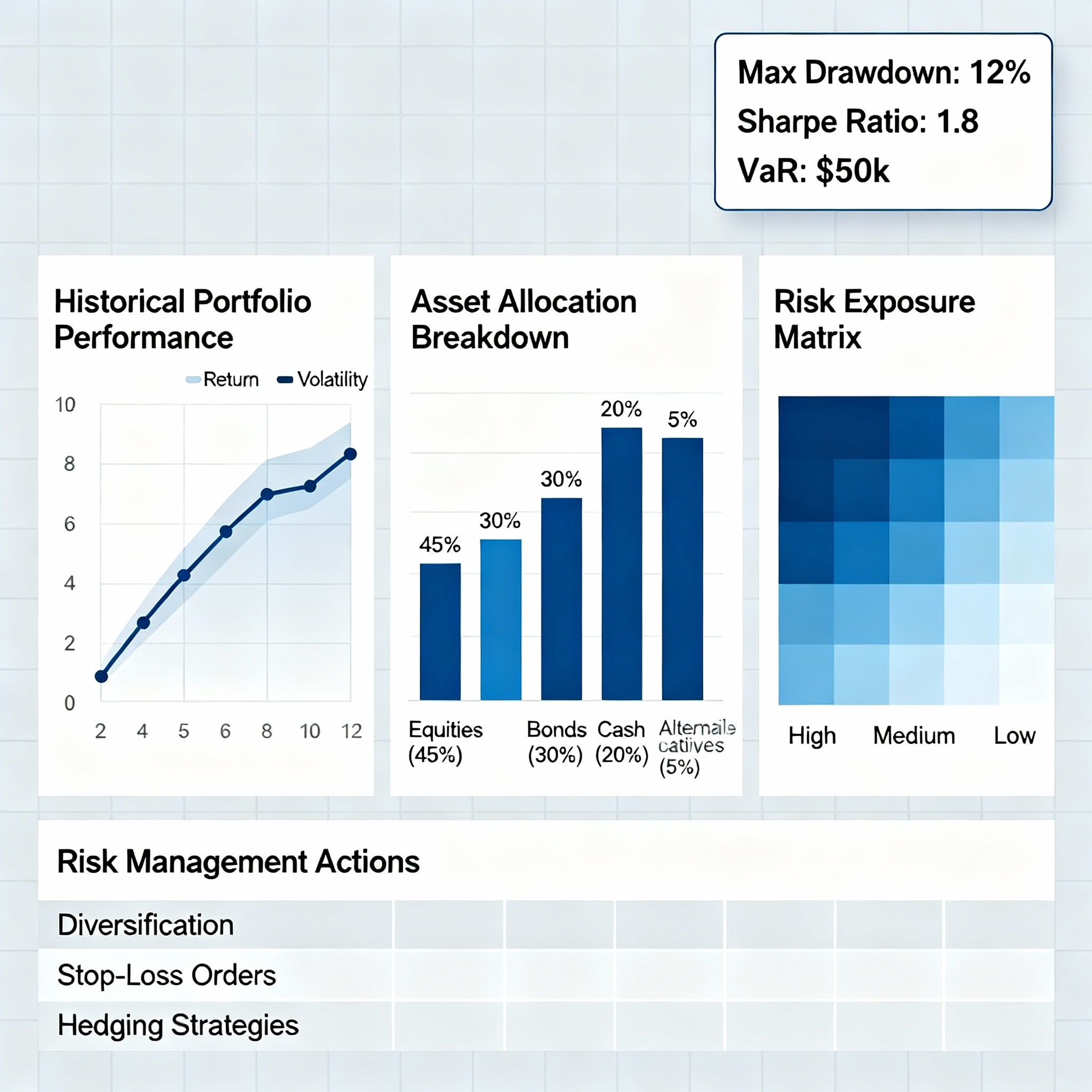
Professional trading risk management strategy infographic with financial dashboard elements
Conclusion: Building Sustainable Risk Management Strategies
Successful trading in 2025 and beyond requires comprehensive risk management strategies that address multiple dimensions of risk including position sizing, diversification, technical analysis, psychology, and ongoing monitoring. These risk management strategies must be integrated into every aspect of the trading process from initial market analysis through position entry, management, and exit. The most effective risk management strategies combine multiple techniques to create robust, redundant protection against various types of losses.
The key to sustainable trading success lies in treating risk management strategies as the foundation rather than an afterthought of the trading process. Risk management strategies should be developed first, tested thoroughly, and implemented consistently before focusing on profit generation techniques. Remember that in trading, capital preservation through effective risk management strategies always takes precedence over profit maximization.
Risk management strategies require continuous learning, adaptation, and refinement as markets evolve and trading experience grows. The most successful traders are those who master these risk management strategies early in their careers and maintain discipline in their implementation regardless of market conditions. By prioritizing risk management strategies and treating them as non-negotiable elements of trading, traders position themselves for long-term success in the challenging world of financial markets.
Trading Strategys branded whiteboard showing risk management techniques with website URL
Disclaimer
This article is for educational purposes only and does not constitute financial advice. Trading in financial markets involves significant risk of loss, and past performance does not guarantee future results. Risk management strategies discussed here are general concepts that may not be suitable for all traders or market conditions. Always conduct your own research, consider your financial situation, and consult with qualified financial professionals before making investment decisions. The implementation of risk management strategies does not guarantee profits or eliminate the possibility of losses. All trading decisions should be made based on your own analysis, risk tolerance, and financial objectives.
#RiskManagement #TradingStrategies #PortfolioRisk #StopLoss #PositionSizing #Trading2025 #RiskAssessment #TradingTips #FinancialRisk #TradingEducation #MarketRisk #TradingSuccess #RiskControl #TradingPlan #InvestmentStrategy